Research
The evidence behind
The Zebra Club
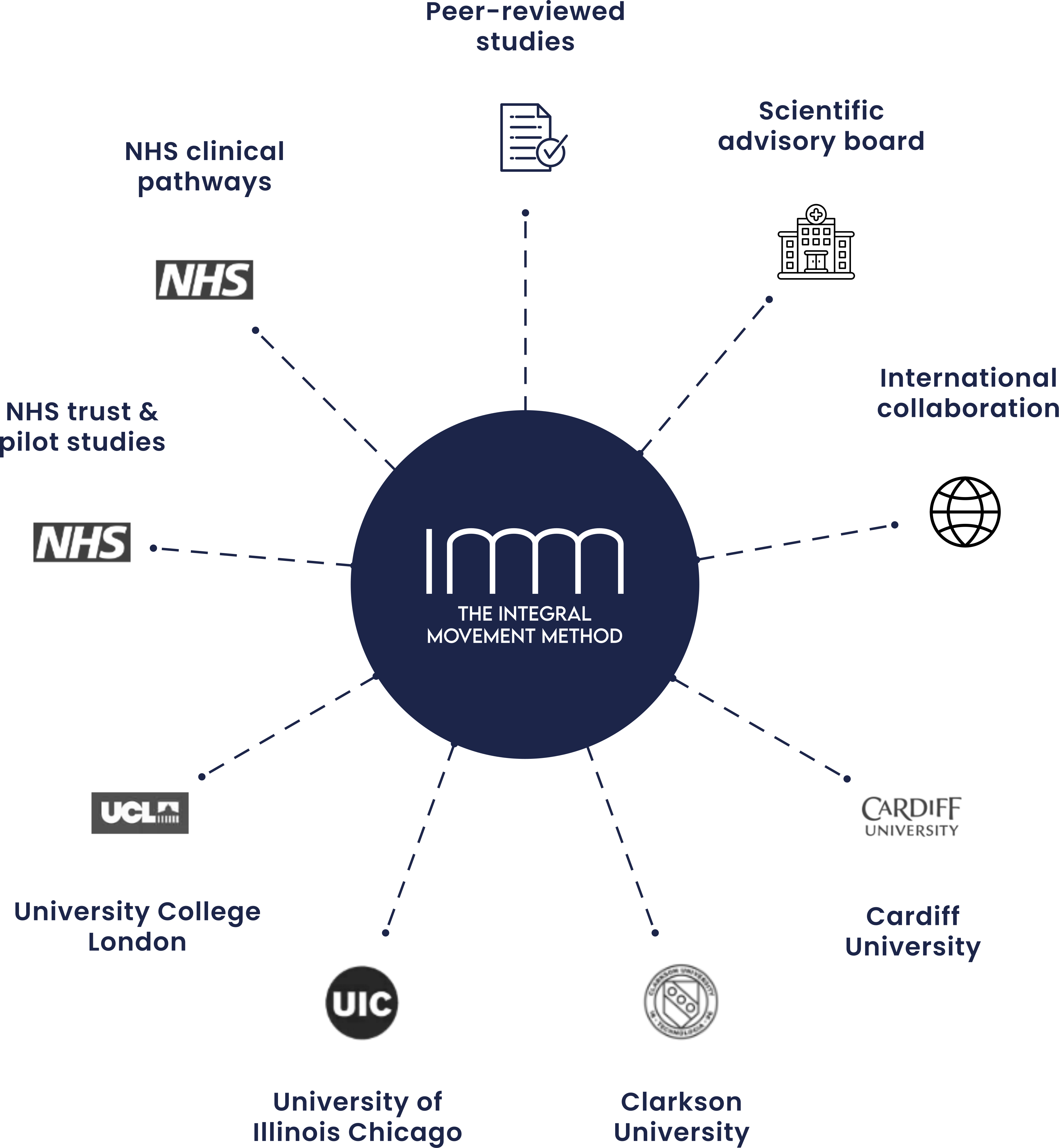
The Integral Movement Method is the only online hypermobility program backed by peer-reviewed research, NHS clinical pathways, and an international scientific advisory board.
Peer-reviewed studies
What research supports The Zebra Club?
Two peer-reviewed studies on the Integral Movement Method have been published in partnership with University College London and Clarkson University. Further research is underway with the University of Illinois and Cardiff University.
Both papers were presented at the Ehlers-Danlos Society International Scientific Symposium, Toronto, Canada, 2025.


An online Pilates program for people with hypermobility: a pragmatic clinical trial.
Journal of Multidisciplinary Healthcare. Russek et al. (2026).
Conducted with University College London (UK) and Clarkson University (NY, US).
Read paperA qualitative study exploring participants' feelings about an online Pilates program designed for people with hypermobility disorders.
Journal of Bodywork and Movement Therapies, 42, 1148–1158. Russek et al. (2025).
Conducted with University College London (UK) and Clarkson University (NY, US).
Read paperOngoing research
 University of Illinois Chicago – In progress
 University of Cardiff – In progress
 NHS Dorset & NHS Kent – Pilot study
The evidence
What the research found
In a peer-reviewed clinical trial, participants following the IMM program for 8 weeks showed measurable improvements in function, body awareness, and fear of movement.
- 88.2% of people would likely or very likely recommend the IMM for hypermobility
- 11.5% decrease in the overall impact of hypermobility on function (BIOH)
- 11.5% improvment in body awareness (BARQ)
- Reduction in fear of movement (TSK)
88.2%
would recommend the IMM for hypermobility
11.5%↓
impact of hypermobility on function (BIOH)
11.5%↑
improvment in body awareness (BARQ)
Reduced
fear of movement (TSK)
Clinical validation
How is The Zebra Club clinically validated?
The Zebra Club holds ORCHA approval, has established active clinical pathways with NHS trusts across the UK, and trains clinicians worldwide in the Integral Movement Method.

ORCHA Approved
The Organisation for the Review of Care and Health Apps (ORCHA) is the NHS's official digital health assessment body. ORCHA approval confirms The Zebra Club meets clinical safety and evidence standards required for NHS recommendation.
NHS Clinical Pathways
An IMM hypermobility clinical pathway is established with NHS Dorset, with a pilot study underway with NHS Kent for post-physiotherapy care.
NHS Clinician Training
IMM training has been delivered to NHS physiotherapists across Dorset, Kent, Sutton, and Leicestershire.
How is The IMM taught to clinicians?
Jeannie Di Bon delivers IMM training to clinicians worldwide, including the EDS ECHO program (Ehlers-Danlos Society) and a certification course at Polestar Pilates UK.

EDS ECHO Program
Jeannie Di Bon delivers IMM training through the Ehlers-Danlos Society's EDS ECHO program, educating clinicians worldwide in hypermobility-specific movement approaches.

Polestar Pilates UK
A certification course at Polestar Pilates UK trains Pilates educators in the Integral Movement Method for hypermobile bodies.
Scientific advisory board
Who advises The Zebra Club scientifically?
The Zebra Club's scientific advisory board brings together leading researchers and clinicians in hypermobility, Ehlers-Danlos syndrome, and related conditions from the UK, US, and New Zealand.

Prof Leslie Russek
Professor Emeritus of Physical Therapy, Clarkson University (US)
IMM ResearchCollaborator on both peer-reviewed IMM studies

Dr Alan Pocinki
Internal Medicine Physician specialising in EDS and dysautonomia (US)
AdvisorEDS & dysautonomia specialist

Dr Fraser Burling
Rheumatologist and Musculoskeletal Physician, Auckland (NZ)
AdvisorRheumatology & MSK medicine

Dr Tina Wang
Physical Medicine and Rehabilitation Physician, fascia researcher (US)
AdvisorPM&R & fascia research
Dr Rebecca Feinstein
Research Director, AI.Health4All Center, University of Illinois Chicago (US)
IMM ResearchLeads ongoing UIC collaboration